Buying a used John Deere riding lawn tractor can be a cost-effective way to maintain your property while still benefiting from John Deere engineering and durability.
However, riding lawn tractors differ significantly from other machines, like compact utility tractors, in their use, maintenance, and wear over time.
Homeowners often operate lawn tractors, store them outdoors in sheds or shops and maintain them inconsistently, which makes it challenging to know what to look for when buying a used one.
RDO Equipment Co. is here to help you in this process so you can avoid unexpected repairs and select a lawn tractor that fits your property and workload. In this article, we’ll break down six tips for choosing a used John Deere Riding Lawn Tractor so you can feel confident in this process.
Key Takeaways
- Match the tractor series to your property and workload first. Buying a model that’s too small for your terrain or acreage can lead to faster wear, poor performance and higher long-term costs.
- Inspect the mower deck closely, it’s the most expensive wear component. Rust, cracks or worn spindles can quickly turn a good deal into a costly repair.
- Evaluate overall condition, not just age or price. Engine behavior, transmission response and steering feel often reveal more about a machine’s history than model year alone.
- Use operator wear points to judge past use and maintenance. Seat condition, pedal wear, steering play and PTO engagement can signal heavy use or deferred maintenance.
Step 1: Choose the Right John Deere Lawn Tractor Series for Your Property
Before evaluating condition or price, your first goals should be to identify the John Deere riding .
Each series is designed for a specific workload, and using a tractor beyond its intended application can accelerate wear. Note: It’s always good to ask what the selling party, or previous owner, used the lawn tractor for.
John Deere 100 & 200 Series: Residential Mowing Applications
Best suited for: Smaller properties, relatively flat terrain and routine mowing.
Typical use to look for: Weekly mowing, bagging and mulching.
The John Deere 100 Series (S140, S160, etc.) and 200 Series are designed for basic residential mowing. These models are lighter and simpler than more advanced models. Their price point ($2,000-$4,000 when new) makes them an accessible option.
If used as intended, an S100 John Deere mower can provide dependable performance for decades. However, operating a 100/200 Series tractor on steep slopes or large acreage can result in premature transmission wear, reduced cut quality and increased maintenance needs.
Watch out for this when evaluating a 100 or 200 series riding lawn tractor.
Why this matters in real life:
If you buy a used 100 Series tractor for a hilly property or several acres because it seemed like a good deal, you may notice slow mowing speeds, transmission strain on slopes and premature wear. What starts as a budget-friendly purchase can quickly turn into repeated belt replacements or a transmission that struggles under load.
John Deere X300 Series: Midrange Lawn and Property Maintenance
Best suited for: Larger residential lawns, moderate slopes and frequent use
Typical use: Mowing, bagging, snow removal and seasonal yard tasks
The John Deere X300 Select Series offers increased durability, heavier frames and improved cut quality over the previous two series. These tractors are commonly chosen by homeowners who mow larger areas or operate attachments like snow blowers regularly.
Selecting an X300 Series tractor for properties that exceed entry-level demands can reduce mowing time, improve cut consistency and extend overall machine life compared to lighter models. Expect to spend $4,000-$8,000 for a new X300 Series riding lawn mower. Depending on the machine’s estimated hours, a used model will be far more cost-effective.
Why this matters in real life:
A homeowner with an acre to mow and several trees may find that a used X300 Series tractor finishes mowing faster, handles obstacles better and delivers a cleaner cut than an entry-level model. Skipping this step and buying too small often means longer mowing times and frustration every weekend.
John Deere X500 Series: Heavy-Duty Residential and Estate Use
Best suited for: Large properties, moderately hilly terrain and frequent attachment use.
Typical use: Mowing, snow removal, hauling and extended operating hours.
The X500 Series is built for demanding residential conditions. Powerful transmissions, traction assistance and heavier construction allow these tractors to perform reliably in applications that would strain lighter machines.
For properties with slopes or year-round attachment use, choosing a tractor in this class helps reduce drivetrain stress and improves long-term reliability. These tractors are more expensive, ranging from $8,500 to $10,000+ for a new model like the X590 and $3,000-$8,000+ for used (depending on condition).
Why this matters in real life:
If you regularly plow snow or mow bumpy terrain, buying a lighter tractor can lead to loss of traction, overheating and drivetrain issues. A used X500 may cost more upfront, but it can prevent repeated breakdowns and replacement costs over time.
John Deere X700 Series: Premium Residential and Estate Applications
Best suited for: Large properties, long operating hours and year-round use (multiple attachments)
Typical use: Mowing, snow removal, material handling and year-round property maintenance.
John Deere’s X700 Series is the top of its riding lawn tractor lineup. These machines are designed for property owners who need maximum durability, power and versatility without stepping up to a compact utility tractor.
When buying used, the X700 Series often delivers strong long-term value because these tractors are built for extended service life. However, they are also more complex machines, which makes condition, maintenance history and proper prior use especially important to evaluate.
Expect new X700 Series tractors to exceed $12,000 depending on configuration, while used models vary widely in price based on hours, attachments and overall condition.
Why this matters in real life:
If you manage several acres, regularly run attachments like snow blowers or carts, or operate on uneven terrain, an X700 Series tractor can deliver smoother operation, better traction and reduced mechanical strain compared to lighter models. Choosing this class when your property demands it can prevent drivetrain failures, overheating issues and repeated repairs that often result from under-sizing your equipment.
Tip #1) Inspect the Mower Deck Thoroughly
The mower deck is the primary wear component on a riding lawn tractor and one of the most expensive to repair or replace. Though it will vary based on the model you choose and the size of the deck, a new mower deck for your riding lawn tractor could run $1,000 or more. Finding a used mower that has a well-maintained deck is your best bet to avoid this expense.
During your pre-purchase inspection:
- Check for rust-through, cracks or structural repairs
- Inspect spindle bearings for noise or excessive play
- Verify belt routing, pulley condition and deck lift operation
- Confirm the deck levels properly and adjusts smoothly
Deck condition directly affects cut quality and operating costs. Even if the tractor runs well, a damaged or heavily worn deck can lead to uneven mowing, vibration and repeated belt or spindle failures.
Tip #2) Evaluate Engine Condition, Not Just Age
Most John Deere riding lawn tractors use gasoline engines and some used models may not be equipped with hour meters. As a result, overall conditions are more meaningful to consider than model year alone.
It’s a good idea to have a trusted technician inspect your machine, but on your own you can look for:
- Cold starting performance: How does the machine sound when starting up for the first time?
- Exhaust smoke under load: Does smoke billow from the engine when pushing down the gas pedal?
- Smooth operation at mowing speed: How does it feel to drive?
- Evidence of oil or fuel leaks
Engines that exhibit hard starting, excessive smoke or unstable operation often require repairs that may exceed the value of an entry-level used tractor.
Tip #3) Test the Transmission and Steering System
Hydrostatic transmissions are common across John Deere lawn tractor models, but repair costs can be significant if problems are present. Make sure you put these systems through their paces when trying out a used machine.
Turn on the machine and find some space to do the following:
- Confirm smooth engagement in forward and reverse
- Test performance under load and on inclines
- Listen for abnormal noise or hesitations
- Check steering response and free play
Transmission performance that feels off during a test drive may worsen under mowing conditions, particularly on slopes or with attachments installed.
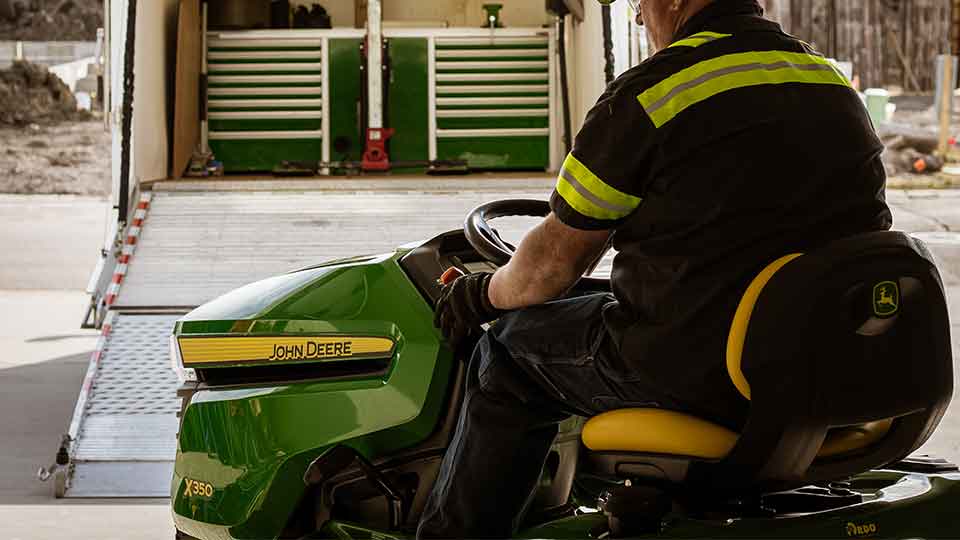
Tip #4) Assess Wear Items and Operator Controls
When you’re evaluating a used riding lawn mower, it can be difficult to tell how much it’s been through – especially if there’s no hour gauge. Wear points often indicate how the tractor was used and maintained under its previous owner.
To get a feel for the wear and tear on other parts of the machine (parts that are more difficult to inspect), look at the following wear points for information:
- Seat condition: Indicators of heavy use are seats that are compressed, cracked or town at the seams. Seat suspension springs/bushings may also be weakened from excessive use. A seat that seems more worn than the mower’s engine hours would dictate can be a sign of over-use on rough terrain or frequent stop-and-go driving.
- Pedal wear: Heavily used pedals will be worn smooth or some of the paint may be peeling. Also watch out for delayed response to foot pressure and poor pedal feel which could be signs of weak return springs.
- Steering wheels: Steering wheels that have seen heavy use will be smooth and/or cracking. One of the most obvious signs of steering wheel issues is loose steering, where there’s too much play in the shaft bushings.
- Blade Engagement Controls/PTO: Depending on the age/model of the lawn tractor, it will have either a manual lever or electronic switch to engage the mower blade. Inspect how these look and function. Delayed response to engagement may be an indicator of deferred maintenance and wear.
Any of these excessive wear signals may suggest heavy use or deferred maintenance, which can increase ownership costs shortly after purchase.
Tip #5) Account for Deferred Maintenance
It’s not uncommon for someone to sell a riding lawn tractor near the end of a mowing season or when maintenance is due. This is important to keep in mind as you evaluate your options because you’ll maybe need to do some touch-ups before you start using the machine.
Plan to pay to replace and update:
- Mower blades ($20-$100)
- Drive and deck belts ($50+)
- Batteries ($70+)
- Tires ($100 +)
- Filters ($20-$50)
Factoring these costs into your purchase decision can provide a more accurate picture of total ownership cost.
Tip #6) Consider Dealer-Inspected Used Equipment
Purchasing a used lawn tractor from an authorized John Deere dealer can reduce much of this uncertainty. RDO thoroughly inspects every piece of used machinery on our lots and performs necessary maintenance on them prior to purchase.
Buying used from RDO means:
- Verified operational and safety checks performed by John Deere certified technicians.
- Known service history if the machine was purchased from the dealer originally.
- Access to genuine John Deere parts
- Optional service or warranty support
For mid and upper-series lawn tractors (like the X739), dealer inspection can help protect long-term value and reliability.
Your Next Step for Buying a Used Lawn Tractor
Buying a used John Deere riding lawn tractor is a big decision. To do this successfully, it’s important to match the tractor to your property and inspect it carefully.
Evaluating its condition by inspecting the mower deck, wear signals and the steering system is important. Also make sure to account for maintenance needs which can help ensure reliable performance and predictable ownership costs.
With the right preparation, a used riding lawn tractor can provide years of dependable service while delivering strong value. Your next step in buying a used riding lawn tractor is to figure out which one is best suited to your property.
Jake Halstensgaard
As an account manager in Breckenridge, Jake is passionate about helping customers around the region (from individual property owners to farmers) find the perfect machine solution for their needs, whether that's a new riding lawn tractor, a used combine, or something in between.