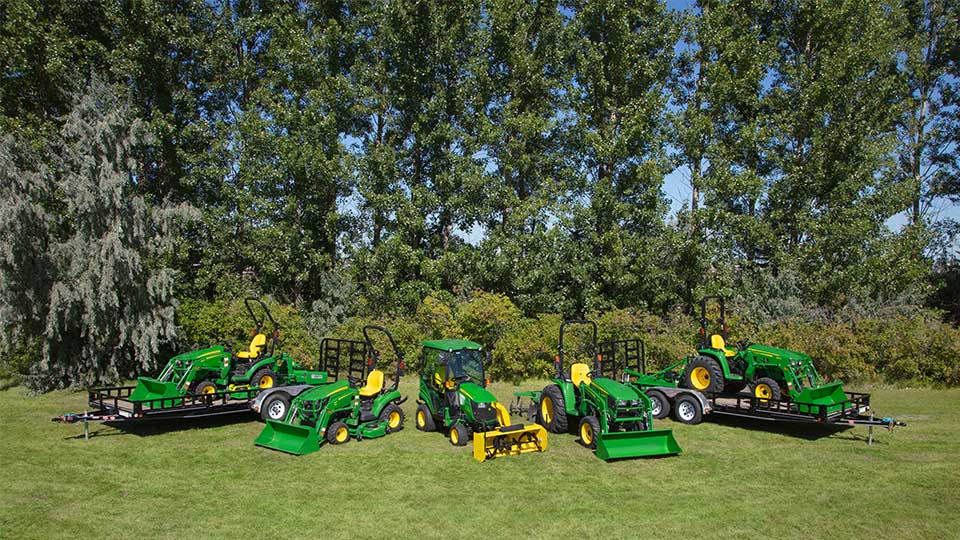
Imagine this: you’re looking over the work ahead, whether it’s maintaining a few acres, managing multiple properties or prepping job sites for clients. The list is long: mowing and dethatching turf, grading gravel drives, clearing debris, maybe trenching for utilities. And when winter rolls in? Snow removal becomes priority number one.
You know a John Deere compact utility tractor (CUT) can make all of these tasks faster and easier. The question is, which model fits your needs best? The 1025R and 2025R are two of the most popular choices, and each brings unique advantages for both residential and commercial applications.
Expect to pay between $18,000 and $23,000 or more, depending on your needs and the tractor’s specifications.
Since you’re making a significant investment, RDO Equipment Co. will help you choose confidently between the 1025R and 2025R.
Let’s explore the main differences between these John Deere CUT models and find out which one suits you best.
Key Takeaways:
- Pick the 1025R if you want a nimble, garage friendly subcompact with the lowest purchase price and excellent all-around capability for residential work.
- Pick the 2025R if you’ll run heavier rear implements, spend longer days in the seat or prefer a bigger, more stable frame that still fits on tight jobsites — popular with landscapers and light construction companies.
1025R Compact Utility Tractor Overview
John Deere has more than 20 models in its compact utility tractor lineup, which includes more than four series.
At RDO, we sell the 1025R more than any other compact utility tractor; over 1,000 new units in the past five years.
If you want a capable machine for your property’s routine tasks, brush cutting, mowing and light loader work, the 1025R is a popular choice among residential owners.
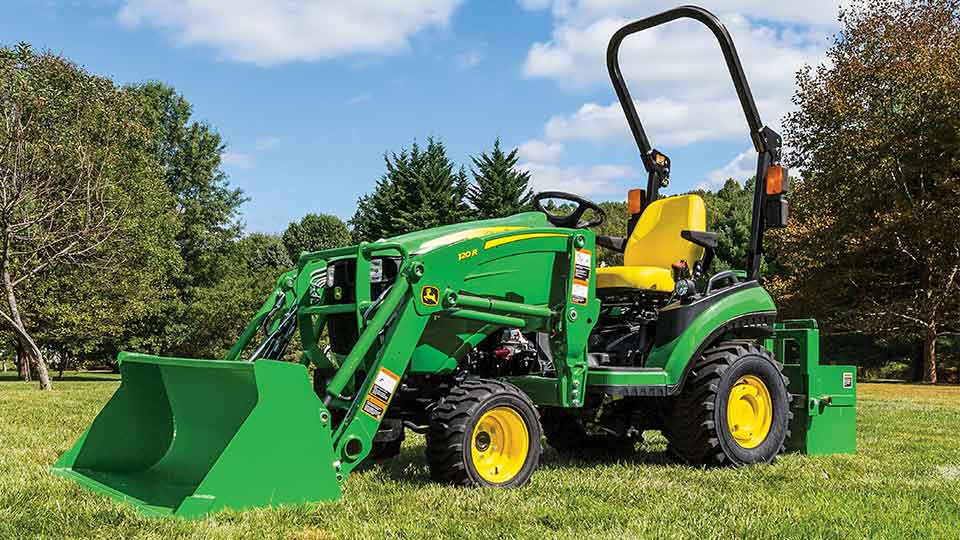
2025R Compact Utility Tractor Overview
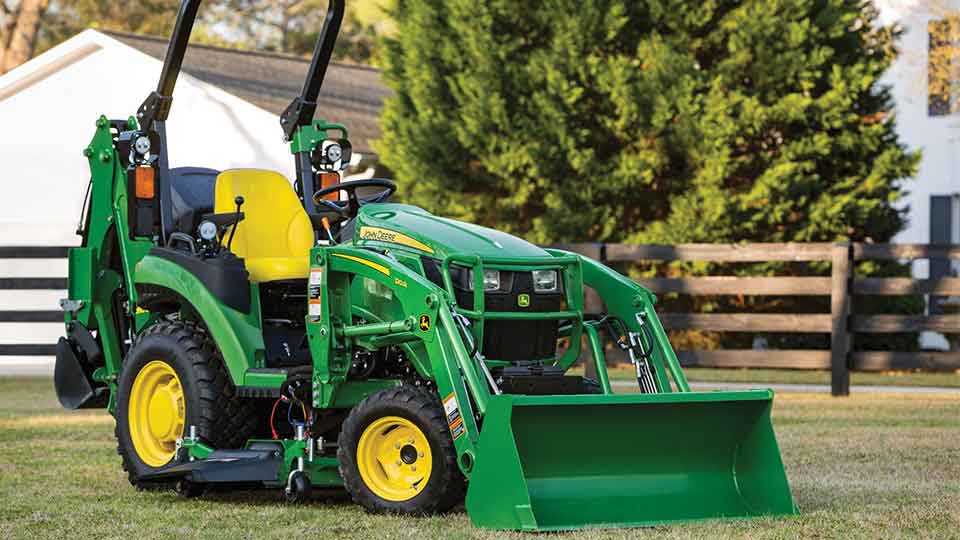
Many customers choose John Deere’s 2025R models as a popular alternative to the 1025R, often taking the next step up in capability. John Deere offers the 2025R as the smallest model in its two series, with a starting price around $21,000.
While some individuals purchase the 2025R, companies in commercial landscaping, construction, ranching or farming frequently select this model for their businesses.
John Deere 1025R vs. 2025R Key Similarities
Both tractors share the same power and other conveniences found in John Deere’s R series. Here are some key similarities:
- 23.9 gross hp Yanmar diesel with about 18.2 PTO hp for implements. PTO hp is what drives tools like a snow blower or rotary cutter.
- Hydrostatic transmission with TwinTouch™ pedals for effortless forward/reverse in loader and mowing work.
- 4WD and power steering standard, so tight turns and obstacle work are easy.
- 120R Quik‑Park™ loader on both models — on/off in about a minute.
- AutoConnect™ drive over mower decks and a healthy ecosystem of compatible implements.
- Factory heated cab option on each (heat only; no A/C). Many owners pop the doors off or open the windows in the summer to make it feel like an open station with a sun canopy.
John Deere 1025R vs. 2025R Key Differences
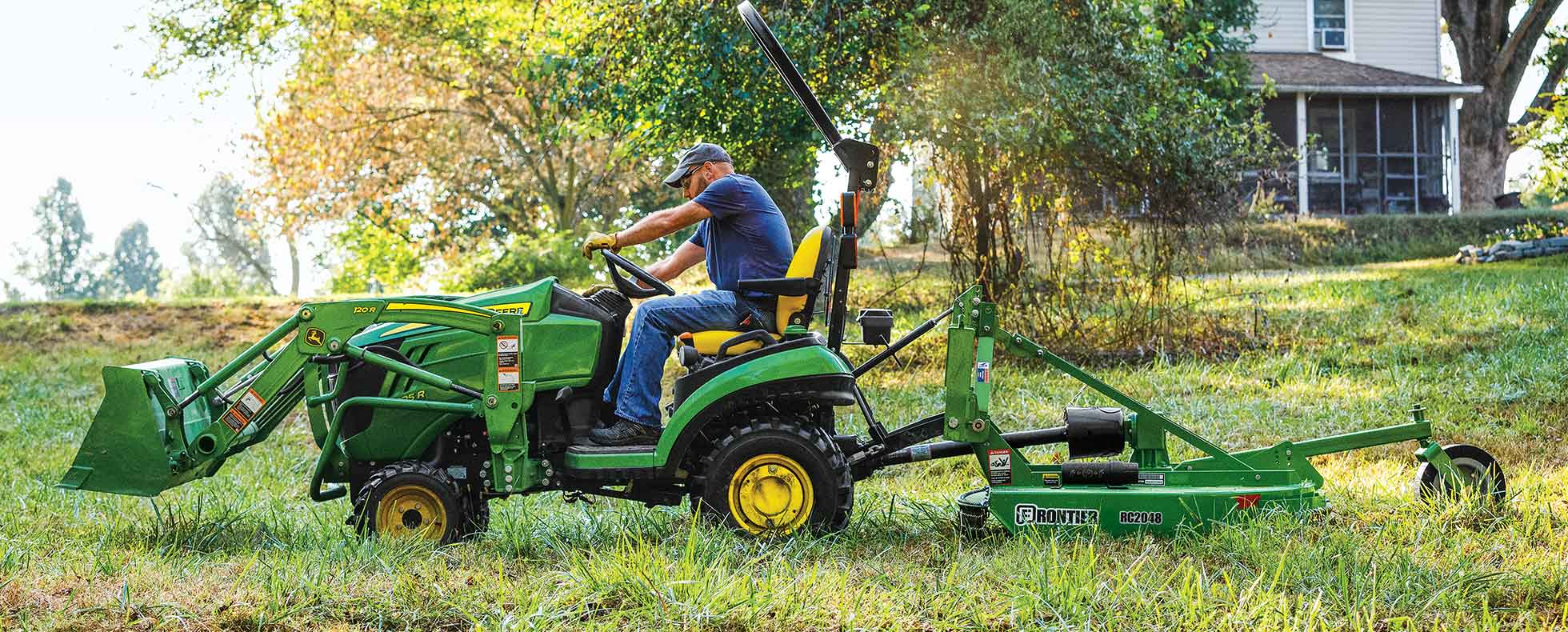
If you’re in the zone where you need a 25-horsepower machine to handle tasks like brush cutting, rototilling, digging, mowing, snow blowing and light loader work, either of these machines can work.
Here are some main differences between the 1025R and 2025R.
Difference 1) Price
The 2025R’s starting price is 10-20 percent more expensive than the 1025R.
While the total amount you pay for your machine will depend on factors like extended warranties, attachments and other upgrades like a factory cab or an iMatch Quick Hitch.
Save some money, regardless of the model you choose, by taking advantage of current promotions.
Difference 2) Size
The other main variant between these machines is in size. The 2025R has a larger frame than the 1025R. Here are two specific differences to note:
Wheelbase:
- 1025R: 57.1 inches
- 2025R: 63 inches
Shipping weight (open station):
- 1025R: ~1,556 lbs.
- 2025R: ~1,872 lbs.
Front Axle Ground Clearance:
- 1025R: 7.7 inches
- 2025R: 10.2 inches
The 2025R’s larger size and weight gives it more traction and stability, especially when performing loader work or using rear implements on uneven terrain.
If your work takes you between trees, through barn aisles, or near buildings, the 1025R’s smaller footprint keeps stress (and scuffs) down.
Difference 3) Three-Point Lift Capacity
The three-point lift at 24 inches behind the link arms measures how much weight a compact tractor can safely handle when you attach implements like box blades, tillers and other tools to the rear.
A higher lift capacity lets you use heavier implements for digging, grading or transporting substantial loads, while also keeping the tractor more stable and balanced on uneven terrain.
The 1025R lifts to 758 pounds at its 24-inch behind link arms, while the 2025R increases that capacity to 916 pounds.
If you plan to use heavier box blades, tillers or ballast-loaded implements, the 2025R’s greater lifting power gives you extra confidence and capacity.
Who Should Go With The 1025R?
If you’re a person who needs a reliable machine for routine tasks around your property, go with the 1025R. Its smaller frame is great for backing through tight gate openings to clean stalls, weaving around trees, operating between buildings and tucking into garage storage.
Starting around $18,000, the 1025R is a straightforward solution, with one caveat: If you’re considering a factory heated cab and using a 260B backhoe, these are not compatible with the 1 series. Instead, you’ll have to go with an aftermarket cab option.

Who Should Go With the 2025R?
Typically, these are the go-to solution for commercial operations who need a 25-horsepower tool with a larger frame, greater ground clearance and higher lift capacity. Comfort is another reason commercial crews gravitate to the 2025R.
The 2025R’s larger chassis offers extra legroom and a “bigger tractor” feel without leaving the 25‑hp class.
If you’ll be putting a lot of hours on your machine, this is a good reason to go with the 2025R – especially if you don’t mind the higher starting price point of around $21,000.
As you evaluate your options, there are a lot of things to consider. How much horsepower you need, how much you’re willing to spend and what kind of tasks you’d like to do are big pieces of the puzzle.


 Choosing Between the 1025R and 2025R: Your Next Step