Whether you're a contractor, landscaper or another type of company that regularly relies on compact construction equipment (CCE), you have a lot to consider every day as you strive to run a profitable, efficient business.
Deciding whether to rent or buy a piece of CCE can significantly impact your operations and bottom line. It can be difficult to decide which of these options makes sense for your business. Each makes sense in different situations.
At RDO Equipment Co., we help customers navigate this decision every day. We’ve outlined key factors to help you decide whether renting or buying makes the most sense for your company’s fleet.
Who Should Consider Renting Compact Construction Equipment?
It’s not always easy to know, but we’ve seen some clear situations where renting works best. Here are four common reasons to rent equipment like compact track loaders and skid steers.
Reason 1) You Have Short-Term or Seasonal Projects
Some companies, such as landscaping contractors, utility and infrastructure companies have flex requirements for their fleet at certain times of the year or when they gain extra business.
If this is your situation, you may want to increase the size of your fleet to maintain efficiency and not disrupt your core operation. Renting can help with this, allowing you the capacity you need without having to spend $30,000-$100,000+ to buy a machine.
Reason 2) You’re Testing New Equipment or Brands
Buying a new piece of equipment and adding it to your fleet is a big decision. It’s common for contractors to try out equipment that’s different from what they currently have when buying something. This can either be a different (or newer) model from the same manufacturer or a product from a different one.
Renting can be an ally in this process — giving you the ability to try out the machine (like upgrading from the 331P to the 335P) without having to buy it outright. This helps many companies see how the equipment performs and integrates over time so they can make a final decision.
Reason 3) You Need Flexibility
Renting allows you to scale your fleet quickly for unexpected demands, seasonal surges or new projects without the constraints of ownership.
For instance, if your company secures a contract that requires a significant increase in equipment for a defined period (say, six months of intensive work) but there’s uncertainty about future workloads, renting offers a flexible solution.
You can acquire the necessary machines, keep your operations running efficiently, and, when the project concludes, simply return the equipment without ongoing financial obligations or the risk of idle assets.
This flexibility is especially valuable for businesses that face fluctuating job requirements or unpredictable market conditions.
By renting, you can meet current needs while avoiding the long-term commitment and potential depreciation that comes with owning machinery.
Reason 4) You Want to Preserve Cash Flow
Another advantage of renting, and a reason why many companies decide to rent versus own certain pieces of machinery is that renting helps you preserve cashflow. Instead of having to pay for the full machine at once, or a portion of its cost through a down payment, you can avoid this by renting.
This can allow you to scale a fleet quickly, without chunking away at the revenue you’re generating. This is particularly a selling point of renting for smaller companies.
What Equipment Makes the Most Sense to Rent?
The kind of equipment it makes sense for you to rent depends on the use case and cost.
Usually, specialty machines you won’t need consistently and only need for one job should be rented.
You can also rent attachments like mulching heads and hydraulic hammers which are expensive to purchase and are specialized enough that you might not need them for every job.
Who Should Consider Owning Compact Construction Equipment?
Owning compact construction equipment (CCE) can be a strategic advantage for many businesses. While renting offers flexibility, ownership provides long-term value and control. Here are four key reasons why owning might be the right move for your company.
Reason 1) You Use the Same Equipment Frequently
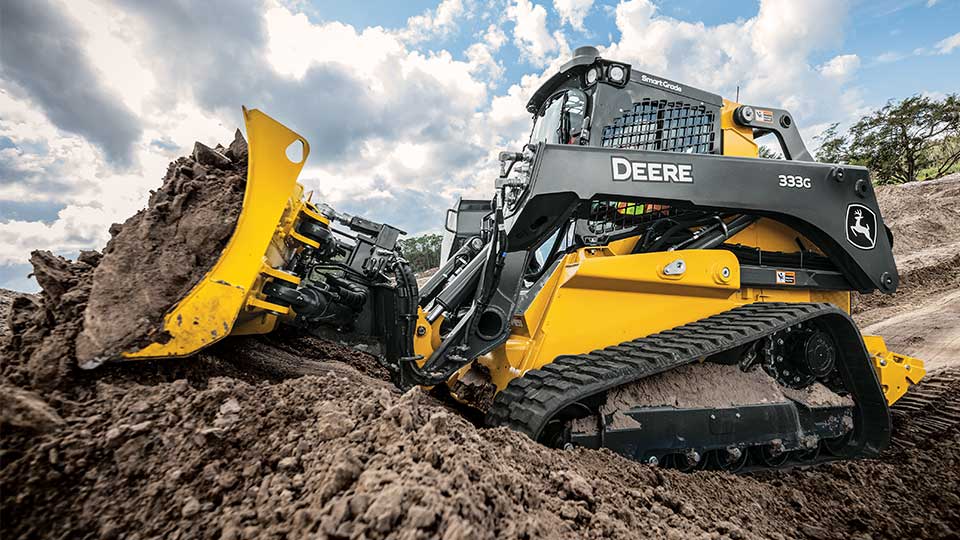
If your business relies on specific machines for daily or weekly operations — such as skid steers, compact track loaders or mini excavators — owning them makes financial and operational sense. Contractors who consistently use models like the 325G or 333P benefit from guaranteed availability and avoid the hassle of coordinating rentals.
Over time, this consistency translates into cost savings and improved job site efficiency.
Reason 2) You Want to Reduce Long-Term Costs
Renting equipment repeatedly can add up quickly.
If you find yourself renting the same machine multiple times a year, purchasing may be more cost-effective.
Monthly payments on a purchased machine, especially with financing options like 0 percent interest, are often lower than ongoing rental fees.
Plus, ownership builds equity in your fleet, giving you a tangible asset that retains value and can be resold or traded later.
Reason 3) You Need Full Control Over Usage and Maintenance
Owning equipment gives you complete control over how and when it’s used.
You’re not bound by rental agreements, hourly limits or surcharges for overuse.
This freedom allows you to deploy machines as needed, without worrying about penalties or restrictions.
Additionally, ownership enables you to manage maintenance schedules directly, ensuring your equipment stays in peak condition and minimizing downtime.
Reason 4) You’re Building a Long-Term Fleet Strategy
For companies focused on growth and long-term planning, owning equipment is a foundational step.
It allows you to standardize your fleet, train your team on specific models and develop strong service relationships with your dealer.
Equipment with high resale value (like John Deere compact track loaders) make ownership a smart investment that supports your business’s future.
Rental vs. Ownership Considerations Table
| | |
| Strong support often provided by dealer, especially for maintenance issues during rental period. | Long-term service relationships; owner has more control over maintenance scheduling and quality. |
| Renter must provide liability coverage for rented equipment. | Owner is responsible for full insurance, liability and maintenance costs. |
| Agreements may include usage limits (e.g., 160 hours/month); surcharges possible for overuse or improper use. | No usage restrictions. Equipment can be used as needed, subject to owner’s discretion and maintenance plan. |
| Typically structured for a month or more; short-term rentals available, good for new customers. | |
Rental Purchase Options (RPO) | Many dealers offer RPOs, allowing rental payments to be applied toward purchase price, creating a bridge from rental to ownership. | Owners may have started with RPO, turning short-term rental into long-term asset. |
| Best for short-term or project-based needs. | Supports growth, fleet standardization, and long-term planning; high resale value on certain equipment. |
Looking to Rent or Own? Your Next Step.
Choosing between renting and owning compact construction equipment depends on your business needs, project duration, financial situation and fleet strategy.
By understanding the benefits and trade-offs of each option, you can make a confident, informed decision that supports your long-term success.
Now that you know what you’re getting by renting instead of owning and vice versa, your next step is to get an accurate price for the equipment you’re interested in.
Si Hanna
Si Hanna is the Vice President of Equipment at RDO Equipment Co., managing inventory levels and fleet valuation, along with supporting machine health and remarketing sales. Hanna began with RDO in 2005 in Compact Construction Equipment (CCE) sales. He has held roles including Store Manager in Hewitt, TX, and General Manager of Remarketing. His first job in equipment was with RDO, and 20 years later, he’s a trusted expert in a rapidly changing industry.